

What Causes Varicocele?
Normally, blood flows from the testicles through the veins toward larger blood vessels. In varicocele, normal venous drainage is impaired, leading to dilation of the veins surrounding the testicle.
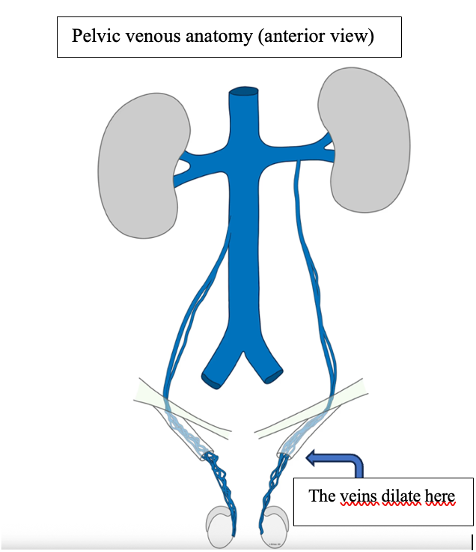
What Are the Symptoms of Varicocele?
Most men with varicocele do not experience significant symptoms.
Possible symptoms include:
- A dull, aching, or pulling pain in the testicle.
- A feeling of heaviness or discomfort in the scrotum.
- Increased discomfort after physical activity or prolonged standing.
- Pain relief when lying down.
- Visibly enlarged veins in the scrotum.
Sometimes, varicocele is first detected during an evaluation for male infertility.
It is important to understand that not all testicular pain is caused by varicocele. Similar symptoms may occur with conditions affecting the epididymis, inguinal hernias, chronic pelvic pain syndrome, or increased pelvic floor muscle tension.
What Are the Potential Complications of Varicocele?
Varicocele itself is generally not a life-threatening condition. However, in some men, it may affect testicular function.
The main potential consequences include:
- Impaired fertility. Varicocele may negatively affect sperm concentration, motility, and morphology, potentially reducing the chances of natural conception.
- Reduced testicular volume. This is particularly important in adolescents.
- Chronic pain. Some patients experience persistent or intermittent discomfort in the scrotum.
However, having a varicocele does not necessarily mean having male-factor infertility. Many men with this condition have normal semen analysis results and become fathers without medical intervention.
How Is Varicocele Diagnosed?
The primary diagnostic method is a physical examination by a urologist.
The doctor examines and palpates the scrotum while the patient is standing, including during the Valsalva maneuver.
There are three clinical grades of varicocele:
- Grade I: Enlarged veins can only be felt during straining (Valsalva maneuver).
- Grade II: Enlarged veins can be felt without straining.
- Grade III: Enlarged veins are visibly apparent.
A scrotal ultrasound with Doppler imaging may also be performed to assess venous blood flow and testicular size.
If a man seeks medical evaluation due to infertility (failure to achieve pregnancy after 6–12 months of trying to conceive), a semen analysis is recommended.
Important: Finding enlarged veins on ultrasound does not automatically mean that surgery is necessary.
When Does Varicocele Require Treatment?
According to the guidelines of the European Association of Urology (EAU) and the American Urological Association/American Society for Reproductive Medicine (AUA/ASRM), surgery is primarily considered in two situations.
1. Varicocele and Infertility
Surgical treatment may be recommended when a varicocele is detectable during a physical examination, the couple is experiencing difficulties conceiving, and semen analysis shows abnormal results.
The reproductive health of both partners must also be taken into account.
2. Varicocele and Chronic Pain
If a patient experiences persistent or intermittent pain, other potential causes must first be ruled out.
If pain characteristic of varicocele persists despite conservative treatment, surgery may be considered.
In the absence of symptoms, with normal semen analysis results and preserved testicular function, surgical treatment is generally unnecessary.
Even a Grade III varicocele is not, by itself, an absolute indication for surgery.
Can Varicocele Be Treated Without Surgery?
Currently, there are no medications that can eliminate the abnormal enlargement of the spermatic cord veins.
Venotonic medications, vitamins, and antioxidants cannot replace surgical treatment when surgery is indicated.
However, if varicocele causes no symptoms and does not affect reproductive function, observation without medication may be recommended.
For patients experiencing mild or moderate pain, conservative (lifestyle and behavioral) measures may help relieve symptoms.
How Is Varicocele Treated Surgically?
One of the preferred surgical techniques is microsurgical varicocelectomy, also known as the Marmar procedure.
During the procedure, the surgeon makes a small incision in the groin area and ligates the enlarged veins while preserving the arteries and lymphatic vessels.
When surgery is performed to address infertility, the first follow-up semen analysis is usually recommended approximately three months after the procedure.
Improvement in semen parameters is possible but cannot be guaranteed.
Similarly, when surgery is performed to treat pain, complete resolution of symptoms cannot be guaranteed.
When Should You See a Urologist?
A urological consultation is recommended if you notice enlarged veins in the scrotum, experience testicular pain or discomfort, observe a change in testicular size, or have difficulties conceiving.
However, if you experience sudden, severe testicular pain, seek emergency medical attention immediately to rule out testicular torsion and other acute conditions.